

Schedule Now & Get $25 Off
Independent kitchen and laundry service for homes and managed properties
Hotpoint Appliance Repair in Tampa, FL
Max Appliance Repair Tampa evaluates qualifying U.S.-market Hotpoint refrigerators, freezers, dishwashers, ranges, microwaves, vent hoods, washers, and dryers.
Send the complete rating plate, exact symptom or cycle stage, and a wide installation photo. For a rental or managed property, include the resident, owner or manager, authorization, access, and utility details needed for the visit.
Seven-day scheduling. Same-day options depend on request time, route, address, model, access, authorization, and parts availability.
Badge and Full Rating Plate
Capture model, serial, suffixes, electrical data, and purchase region if known.
Appliance and Utility
Identify gas/electric, compact/full-size, portable, built-in, or freestanding.
Occupancy and Authorization
Name the resident, owner or manager, on-site contact, and decision maker.
Access and Current Evidence
Show the installation and preserve codes, lights, temperatures, leaks, and cycle stage.
Current U.S. product scope, not a generic global brand list
Which Hotpoint Household Appliances Can We Evaluate?
Hotpoint’s official U.S. catalog currently centers on practical refrigeration, cooking, dishwashing, and laundry products. We review qualifying kitchen and laundry requests by exact model and installation. The name also appears on PTAC and ductless equipment, but this page is intentionally focused on Max’s household major-appliance work.
Top-Freezer and Compact Refrigeration
Qualifying top-freezer and compact refrigerators plus upright freezers may be reviewed for temperature loss, frost, moisture, noise, door, gasket, hinge, light, control, defrost, or power complaints. Record actual temperatures and protect food first.
Show the entire cabinet and surrounding clearance. A compact unit under a counter, an upright freezer in a garage, and a top-freezer refrigerator in a rental kitchen can have different airflow, ambient-temperature, floor, door, and access conditions even when the symptom is simply “warm.”
Dishwashers
Qualifying Hotpoint dishwashers can be evaluated for fill, circulation, cleaning, drain, leak, drying, latch, rack, spray, noise, code, light, or control concerns. The selected program and failure stage are more useful than a guess about one part.
In a rental, note recent sink, disposal, drain, plumbing, cabinet, flooring, or tenant changes. Household drainage, a moved hose, unavailable hot water, loading, detergent, or installation can resemble an internal dishwasher problem.
Ranges, Microwaves, and Vent Hoods
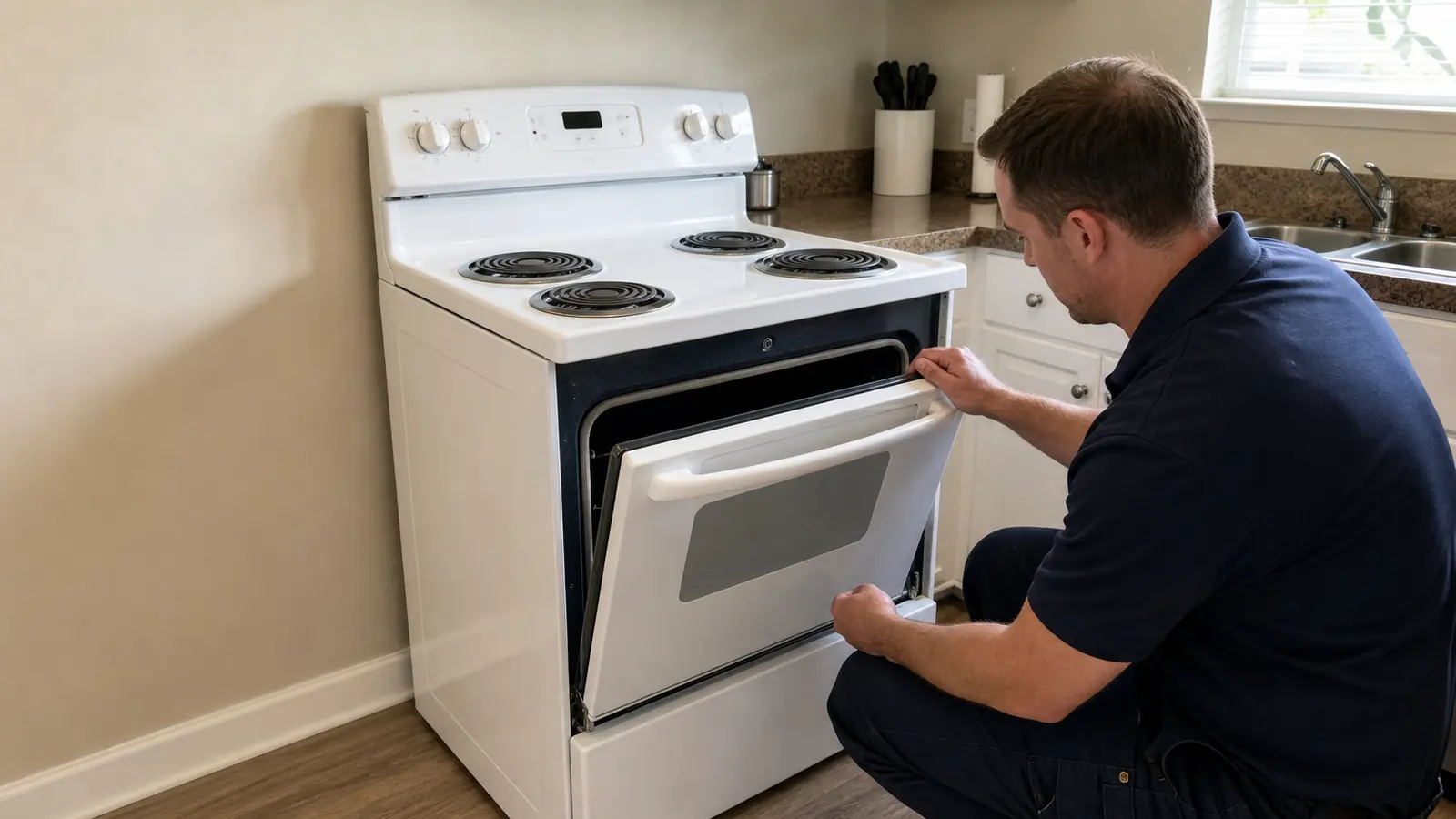
Qualifying gas and electric ranges, built-in or over-the-range microwaves, and vent hoods may be reviewed for ignition, coils, elements, oven temperature, doors, hinges, gaskets, lights, fans, airflow, displays, controls, power, or codes.
Identify gas or electric and photograph the full installation. A freestanding coil-top range, a hardwired cooking product, an over-the-range microwave, and a hood each have different utility, mounting, cabinet, and safety requirements. Never remove a microwave cover or defeat an interlock.
Range repair services →Oven repair services →Microwave repair services →
Washers and Dryers
Qualifying washers, gas and electric dryers, and portable or stationary electric dryers may be reviewed for fill, drain, spin, balance, lid or lock, tumble, heat, airflow, cycle time, noise, movement, leak, code, or light-pattern complaints.
Show hoses, standpipe, outlet or gas context, floor, clearance, and dryer vent route where applicable. Portable and space-saving products need their exact model and utility setup; the product name alone does not establish voltage, drainage, exhaust, or access.
Safety first: Stop use and call the appropriate emergency or utility resource for gas odor, smoke, arcing, active flooding, severe overheating, a damaged connection, or another immediate hazard. Do not move a gas-connected, hardwired, built-in, stacked, or heavy appliance solely to find a label.
The badge is the starting point, not the full identification
Is Your Hotpoint Appliance a U.S. Model or a European Model?
Hotpoint’s U.S. support page makes a regional distinction: U.S. appliances are registered with GE Appliances and U.S. factory service is routed through Bodewell, while products purchased in Europe use a separate European support path. For independent repair in Tampa, the complete rating plate and purchase context help prevent the wrong manual, parts path, electrical assumption, or service expectation.
Evidence of a U.S.-market Hotpoint
- The appliance came through a U.S. retailer, builder, landlord, or property supplier.
- The rating plate shows U.S. electrical data and a model that resolves through U.S. Hotpoint or GE Appliances support.
- Registration, manual, warranty, or service documentation points to GE Appliances or Bodewell.
- The product category matches the current U.S. lineup: practical refrigeration, dishwashing, cooking, microwave/hood, or laundry.
Still send the full plate. A receipt description or a few leading characters can omit manufacturing suffixes used for service and parts identification.
Independent-service note: Max Appliance Repair Tampa is not Bodewell or Hotpoint factory service. Active warranty, recall, safety-notice, or factory-directed requests should be checked with the official path first.
Evidence that needs regional clarification
- The appliance was purchased or previously used in Europe, imported, or moved with an international household.
- The manual, retailer, plug, voltage, frequency, model format, or support address points outside the U.S.
- The appliance type or feature set does not resemble the U.S. Hotpoint catalog.
- Parts or documentation searches return only a European site or a different regional service organization.
Do not use a travel adapter, alter a plug, or energize an appliance with uncertain voltage or frequency merely to reproduce the symptom. Send the plate and documentation first.
Service fit can differ: regional model, parts support, electrical compatibility, installation, and documentation may affect whether independent local service is appropriate.
A successful visit needs the fault, the access, and the authority
How Should a Hotpoint Repair Request Work in a Rental or Managed Property?
Hotpoint’s own professional marketing speaks to property managers and tenant use. For a Tampa repair request, the useful part is not a durability slogan; it is a clean handoff between the person who sees the symptom, the person who owns or manages the appliance, and the technician who needs safe access and approval.
Resident or on-site observer
Preserve what happened
Record the appliance, date, time, cycle or stage, exact code or light pattern, sound, temperature, leak origin, odor, and whether the condition repeats. A short safe-distance video can capture intermittent noise or movement.
Note whether the appliance was reset, unplugged, cleaned, moved, overloaded, or used after the issue. Report any recent move-in, delivery, outage, utility interruption, drain backup, flooring, painting, renovation, or pest treatment.
Confirm availability, pets, gate or lockbox instructions, parking, and whether an adult can provide access. Do not authorize work you are not permitted to approve.
Owner, landlord, or manager
Define authorization and decision path
Identify who owns the appliance, who approves diagnosis, who approves repair, the spending or communication process, and who receives findings. Provide the correct billing/contact information without putting sensitive payment data in a public form.
Confirm unit number, resident notice, building access, service hours, elevator or loading rules, vendor documents, utilities, shutoffs, floor protection, and whether a maintenance person must attend.
If replacement is already under consideration, share portfolio standards, opening dimensions, utility constraints, delivery path, and downtime needs so the repair-versus-replace discussion uses installed reality.
Service visit
Verify before parts assumptions
The technician reviews the rating plate, reported evidence, configuration, utilities, installation, and safety before testing the affected system. A low-cost or simple-looking appliance still deserves model-specific diagnosis.
Findings and options go to the authorized decision maker. Work proceeds only after the appropriate approval and when parts, access, conditions, and service fit allow.
This workflow serves homeowners and residents too: the same person may fill all three roles. The point is to avoid a visit where the appliance is present but the evidence, access, utilities, or authority are missing.
Document the state before turnover cleanup erases it
What Should You Record Before Resetting or Moving a Hotpoint Appliance?
A reset can sometimes clear a temporary control condition, but it can also erase a code, change a cycle state, or make an intermittent complaint harder to reproduce. In a rental turnover, cleaning and moving can change hoses, vents, floors, doors, power, and evidence. Capture the safe, visible facts first.
Record 1
Whole Appliance and Installation
Take one wide photo showing the full product, floor, walls, cabinets, doors, countertop, hoses, vent route, sink base, standpipe, outlet, gas context, and available service path as applicable.
This identifies a compact, portable, freestanding, built-in, or space-limited installation before close-up photos hide the context.
Record 2
Full Rating Plate
Photograph model, serial, prefixes, suffixes, punctuation, and electrical data in one readable frame. Add a second close photo only if glare prevents a character from being read.
Do not copy only the model printed on a receipt, listing, door sticker, or online product page; the appliance plate is the identification source.
Record 3
Exact State and Sequence
Capture the display, code, blinking lights, selected program, elapsed stage, temperature, water level, leak origin, sound, movement, heat, airflow, door or lid state, and final result.
Write what occurred immediately before and after the symptom rather than only “not working.”
Record 4
Recent Changes and Safety
Note outage, move-in, tenant turnover, delivery, cleaning, plumbing, disposal, drain, gas, electrical, flooring, cabinet, vent, hose, breaker, or appliance movement.
For gas odor, smoke, arcing, active flooding, severe heat, or damaged connections, stop use and prioritize the correct emergency or utility response.
A symptom is a branch, not a remote diagnosis
What Common Hotpoint Appliance Symptoms Can Mean
These eight routes help an owner, resident, or manager collect useful information without guessing a failed part. Similar symptoms can begin with the appliance, its utility, installation, load, household plumbing, airflow, ambient conditions, or a recent property change.
Refrigerator or Freezer Is Warm
Record measured temperatures, food-safety action, frost location, door closure, fan and compressor sounds, control setting, lights, power/outage history, load, ambient room, and clearance. Keep safe evidence without repeatedly cycling power.
Frost, Moisture, or Door Trouble
Photograph the pattern and door alignment. Loading, gasket contact, hinge, leveling, drainage, airflow, defrost, ambient humidity, or a cooling/control condition can create different paths.
Dishwasher Will Not Drain or Dry
Note program, failure stage, water level, drain sound, filter condition through normal access, sink/disposal changes, plumbing symptoms, water temperature, rinse aid, code, and leak origin.
Range Burner or Oven Will Not Heat
Identify gas or electric, affected burner/coil/oven, selected mode, ignition or element behavior, temperature pattern, display, code, and whether recent cleaning, movement, outage, or utility work occurred.
Washer Will Not Fill, Drain, or Spin
Record the stage, water supply, drain path, standpipe, load, balance, lid or lock, floor, hoses, sounds, movement, lights, and code. H2O, IE, UE, lid, or other messages vary by model.
Dryer Tumbles but Does Not Dry
Identify gas or electric and portable or stationary configuration. Note heat, airflow, cycle time, load, lint path, vent route where applicable, outlet/breaker context, room conditions, and whether the symptom changed after movement.
Appliance Leaks
Stop active water, protect the area, and photograph the first visible location without removing panels. Record cycle stage, water level, door/lid, detergent, hoses, sink/drain behavior, recent movement, and whether it leaks while idle.
Noise, Movement, Code, or Blinking Lights
Capture a short safe-distance recording and the full display/pattern. Note exact stage, load, floor, cabinet contact, recent move, and whether impact, grinding, odor, leakage, uncontrolled water, or severe heat makes continued use unsafe.
Every character can change the lookup
Why Does the Complete Hotpoint Model and Serial Label Matter?
Official support explains that rating-plate locations vary and that extra model letters or numbers can carry manufacturing-specific information used for service and parts. That is why an online listing, old work order, receipt shorthand, or a model copied without the ending characters is not enough for a careful request.
Capture the complete identity in one frame
- Model number from the appliance rating plate, including every prefix and suffix.
- Serial number and any manufacturing or revision characters shown beside it.
- Electrical data, especially when regional origin, voltage, frequency, portable configuration, or utility is uncertain.
- One wide appliance photo showing whether it is a top-freezer, compact, upright, gas/electric range, dishwasher, washer, gas/electric dryer, portable dryer, microwave, or vent hood.
- Purchase region, retailer, builder, landlord, manual, registration, or prior-service context when available.
Check normal owner-access locations first: door or lid openings, frames, drawers, tub walls, and visible cabinet surfaces. The exact owner’s manual may provide model-specific guidance.
Do not move for the label alone. A rear tag is not a reason to drag a loaded refrigerator, pull a range across flooring, disconnect gas, lift a stacked appliance, remove cabinetry, or expose internal microwave or electrical components.
Do not lose the suffixes
PrefixBase modelSuffixSerialElectrical dataRegion
A partial number can appear plausible and still point to the wrong revision, manual, control, connection, component, or support path. Photograph rather than transcribe when possible.
When the tag is not safely visible
Send the wide installation photo, badge, appliance type, accessible documentation, and any partial number with a clear note that it is incomplete. That information can guide a safer next step without pretending the product is fully identified.
When the model looks European
Include the plug, voltage/frequency plate, manual language, retailer or country, and model label. Do not power an uncertain import with an adapter simply to test it.
Compare the diagnosed repair with the installed replacement
Should You Repair or Replace a Hotpoint Appliance?
A practical purchase price does not automatically make repair wrong, and age alone does not make repair right. Compare the diagnosed fault, parts support, cabinet/tub/drum/liner condition, prior history, safety, water or heat damage, downtime, access, authorization, and the total cost of putting a suitable replacement into the same opening.
Repair may be reasonable when
- The fault is identifiable and the repair is proportionate to age, condition, and remaining value.
- The cabinet, tub, drum, liner, wiring, utilities, and structure are otherwise sound.
- The appliance fits a rental opening, utility, or portable/compact need that is not simple to replace.
- Parts and safe access are supportable and there is no broader damage pattern.
- Repair can reduce unit downtime without ignoring a planned renovation or portfolio standard.
Replacement deserves more weight when
- Multiple major systems are deteriorated or the fault is part of repeated failures.
- Corrosion, cabinet damage, water damage, unsafe utility conditions, or repeated leaks raise risk.
- Parts support is uncertain or repair approaches the installed value of a suitable replacement.
- Capacity, region, voltage, configuration, or condition no longer fits the household or property.
- The owner or manager already plans coordinated replacement, renovation, or standardization.
Installed replacement cost can include delivery, old-unit removal, elevator or loading reservations, flooring protection, doorway clearance, cabinetry, trim, hoses, drain, outlet, venting, gas/electrical work, resident coordination, and time without a working appliance.
Identify, authorize, diagnose, then decide
What to Expect From Your Hotpoint Service Request
The process is the same whether one homeowner fills every role or a resident, manager, and owner share the handoff: confirm the product and access, evaluate the reported stage, explain findings to the authorized person, and proceed only with approval.
Step 1
Request Review
Share the complete label, region if uncertain, symptom, evidence, address, ZIP, installation photo, occupancy, access, utility, and authorization details. Service fit and route are confirmed.
Step 2
On-Site Diagnosis
The technician reviews the reported condition, configuration, utilities, installation, and safety, then tests the relevant system and cycle stage where conditions permit.
Step 3
Findings and Authorization
The authorized decision maker receives the findings and proposed next step. Parts, labor, access, condition, downtime, and repair-versus-replace context can be considered before work proceeds.
Step 4
Approved Work and Check
Authorized work is completed when feasible, followed by a relevant functional check. Eligible repair parts installed by Max include a limited 90-day parts warranty; coverage depends on the component and repair.
Local route, occupancy, and access confirmation
Hotpoint Appliance Repair Across the Tampa Bay Area
Requests are reviewed across Tampa and many nearby Hillsborough, Pinellas, and Pasco County communities. Availability varies by address, route, exact model and region, appliance and utility, safe access, authorization, building requirements, and parts situation.
All Service AreasTampaClearwaterDunedinSt. Petersburg
For an occupied unit, confirm the resident and adult access window. For a vacant unit, confirm key, lockbox, gate, alarm, utility, parking, elevator, service-hour, and authorization arrangements without placing sensitive access codes in a public message.
Direct answers for owners, residents, and property managers
Hotpoint Appliance Repair FAQs
Answers about supported U.S. appliances, European-model identification, rental authorization, tenant evidence, refrigeration, cooking, dishwashers, laundry, codes, model labels, scheduling, and independent service.
Which Hotpoint appliances do you repair in Tampa?
We evaluate qualifying U.S.-market Hotpoint top-freezer and compact refrigerators, upright freezers, dishwashers, gas and electric ranges, built-in and over-the-range microwaves, qualifying vent hoods, washers, gas and electric dryers, and portable or stationary electric dryers. Service fit depends on the complete model and serial number, purchase region, appliance type, utility, installation, condition, safe access, authorization, symptom, and parts support.
Is a U.S. Hotpoint appliance the same as a European Hotpoint appliance?
A Hotpoint badge alone does not establish the regional product or support system. Hotpoint’s U.S. support page says U.S. appliances are registered with GE Appliances and routes U.S. factory service through Bodewell, while products purchased in Europe use a separate European support path. Send the complete rating plate, purchase region if known, voltage and plug context for an import, and any manual or retailer documentation so the request is not routed from the logo alone.
Can a landlord or property manager request Hotpoint appliance repair?
Many qualifying rental and property-managed requests can be reviewed. Identify the appliance owner, resident, on-site contact, decision maker, and person authorized to approve diagnosis, parts, labor, or replacement. Include the unit number, tenant availability, gate or lockbox process, parking, stairs or elevator, service hours, pets, floor-protection rules, utility status, and any vendor-document requirements. This page does not imply a property-management contract program; each request is confirmed individually.
What should a tenant send before a Hotpoint service visit?
Send a wide photo of the appliance and installation, a clear photo of the entire rating plate, the exact symptom, code or blinking-light pattern, cycle or stage, when it began, and whether the condition is intermittent. Note recent move-in, delivery, cleaning, outage, plumbing, electrical, flooring, renovation, or appliance movement. Confirm who owns the appliance and who can approve work. Do not move the appliance, remove panels, or repeatedly reset it merely to gather more evidence.
Can you repair a Hotpoint refrigerator or upright freezer that is warm?
Many qualifying top-freezer, compact-refrigerator, and upright-freezer requests can be evaluated. Record actual compartment temperatures, food-safety action, when the change began, frost or moisture location, fan and compressor sounds, door closure, gasket contact, control setting, power or outage history, and surrounding clearance. A warm cabinet can involve power, controls, airflow, doors, defrost, fans, sensors, compressor or sealed-system branches; one symptom does not name the failed part.
Do you repair Hotpoint gas and electric ranges, microwaves, and vent hoods?
Qualifying U.S.-market Hotpoint gas and electric ranges, built-in or over-the-range microwaves, and vent hoods can be reviewed by exact model. Common requests involve ignition, coil or element heat, oven temperature, doors, hinges, gaskets, controls, displays, fans, lights, airflow, or codes. Gas odor, arcing, smoke, severe overheating, a damaged connection, or microwave high-voltage conditions require immediate safety action; do not remove covers or defeat an interlock.
Can you repair a Hotpoint dishwasher that will not drain or dry?
Many qualifying Hotpoint dishwashers can be evaluated for fill, circulation, drain, leak, cleaning, drying, latch, rack, spray, noise, code, or control complaints. Record the selected program and the stage where the problem begins, standing-water level, drain sound, sink or disposal changes, household-plumbing symptoms, water temperature, rinse-aid use, and visible leak origin. Drain and dry complaints have different branches and should not be reduced to one assumed pump or heater.
Do you service Hotpoint washers and dryers?
Qualifying U.S.-market Hotpoint washers, gas and electric dryers, and portable or stationary electric dryers can be reviewed. For washers, record fill, wash, drain, spin, balance, lid or lock, hoses, standpipe, floor, load, and code or light pattern. For dryers, identify the utility and configuration and record tumble, heat, airflow, cycle time, load, lint path, vent route where applicable, outlet or breaker context, and any odor or abnormal temperature.
What do Hotpoint washer codes or blinking lights mean?
Messages and light patterns vary by model and indicate a detected condition, not a guaranteed failed component. Official support for related GE/Hotpoint platforms describes examples involving out-of-balance loads, water supply, lid state, UE, and FE. Photograph the whole display or record the complete light pattern and exact cycle stage before resetting. Follow the specific owner’s manual; for uncontrolled water, leakage, FE, smoke, arcing, burning odor, or severe heat, stop use and act on safety first.
Where is the Hotpoint model and serial number?
Rating-plate position varies by appliance and model. Check normal owner-access door, lid, frame, drawer, tub-wall, and cabinet openings first, and use the specific owner’s manual when available. Photograph the entire plate, including prefixes, suffixes, punctuation, model, serial, and electrical data. Official support explains that extra model letters or numbers can identify manufacturing-specific information used for service and parts. Do not move a heavy, gas-connected, hardwired, built-in, or stacked appliance solely to reach a rear tag.
Is same-day Hotpoint appliance repair available?
Same-day appointment options are often available, but they depend on request time, technician route, Tampa-area address, exact model and region, appliance and utility, safe access, resident or manager authorization, building rules, fault type, and parts availability. Call (813) 906-1062 with the complete rating plate, symptom, service address, ZIP code, occupancy status, and contact roles so the earliest suitable opening can be confirmed rather than promised without the details.
Is Max Appliance Repair Tampa authorized by Hotpoint or GE Appliances?
No. Max Appliance Repair Tampa is an independent appliance repair company and is not Hotpoint, GE Appliances, Bodewell, or European Hotpoint factory service and is not authorized by, affiliated with, or endorsed by those companies. For active manufacturer or retailer warranty coverage, a recall, safety notice, regional-support question, or factory-directed request, contact the appropriate official support path before arranging independent service.
Sources used for product scope and owner guidance: Hotpoint’s official U.S. product catalog, home and product overview, property-manager/pro positioning, U.S. appliance support, registration, Bodewell, and Europe distinction, washer and dryer scope, cooking scope, dishwasher scope, GE Appliances’ model and serial-number information, extra model-character information, GE and Hotpoint washer electrical requirements, and washer Consumer Help Indicator information. Symptoms and messages are diagnostic starting points, not remote diagnoses.
Independent service disclosure: Max Appliance Repair Tampa is an independent appliance repair company and is not Hotpoint, GE Appliances, Bodewell, or European Hotpoint factory service and is not authorized by, affiliated with, or endorsed by those companies. Brand and product names identify appliances discussed or serviced. For manufacturer/retailer warranty, recall, safety notice, regional-support, or factory-directed service, contact the appropriate official support path.
Brand-scope and owner-support information reviewed August 1, 2026. View all appliance brands we repair.
Need Help With a Hotpoint Appliance?
Call with the full rating plate, region if uncertain, exact symptom or stage, installation photo, address, access, occupancy, and authorization details, or send the information online.