

Schedule Now & Get $25 Off
Major kitchen appliances, built-in access, and exact-model guidance
KitchenAid Appliance Repair in Tampa, FL
Max Appliance Repair Tampa evaluates qualifying KitchenAid refrigerators, dishwashers, ranges, wall ovens, cooktops, microwaves, undercounter refrigeration, ice makers, hoods, warming drawers, and compactors.
Send the complete model/serial label, exact symptom, wide installation photo, and Tampa-area ZIP code. For built-in, panel-ready, flush, or combination products, show the cabinets, trim, doors, floor, ventilation, utilities, and safe access path.
Seven-day scheduling. Same-day options depend on request time, route, complete model/configuration, access, safety, and parts availability.
Product Family
Installed major appliance or portable countertop product.
Complete Rating Plate
Photograph every model, serial, suffix, revision, and product-data character.
Symptom Evidence
Record cycle or mode, stage, temperature, water, heat, airflow, sound, code, and result.
Built-In Access
Show panels, trim, cabinets, floor, doors, ducts, utilities, and movement path.
Start with the kind of KitchenAid product
Which KitchenAid Product Needs Attention?
KitchenAid uses separate support, labels, manuals, and warranty routes for installed major appliances and portable countertop products. Identifying that product family first prevents a stand-mixer search from being mixed with a built-in refrigerator, wall oven, or dishwasher service request.
Max major-appliance intake
Installed major kitchen appliance
Use this page when the product is built into cabinetry, installed under a counter, connected as a range, refrigerator, dishwasher, wall oven, cooktop, microwave, ice maker, hood, warming drawer, or compactor, or otherwise falls within the qualifying major-appliance categories described below.
- Photograph the complete rating plate.
- Show the full appliance and installation.
- Record the exact behavior and safety context.
- Include the service address and ZIP code.
Service fit is confirmed from the model, configuration, access, safety, condition, and parts support.
KitchenAid countertop support route
Portable stand mixer or countertop product
KitchenAid’s current countertop family includes products such as stand mixers, blenders, food processors, hand mixers, and toasters. Those products use different model-label locations, documentation, warranty terms, and service channels from major appliances.
For a portable product, use KitchenAid’s current official service and support page. If the family is unclear, send Max one wide product photo and the full rating plate before choosing a route.
This distinction keeps the page accurate without implying that every product carrying a KitchenAid name belongs to the same service system.
Current kitchen categories relevant to Max
Which KitchenAid Major Appliances Can We Evaluate?
KitchenAid’s current U.S. built-in and major-appliance pages are kitchen-focused. The categories below match that official product context to Max’s established service scope; they are not a promise that every model, installation, safety condition, or discontinued part situation can be serviced.
Refrigerators and Freezers
Qualifying built-in, French-door, side-by-side, bottom-freezer, freezer, column, and freestanding configurations may be reviewed for temperature, frost, moisture, door, gasket, fan, noise, control, water, or power concerns.
Built-In Dishwashers
Qualifying front-control, top-control, panel-ready, and other built-in dishwashers may be reviewed for fill, wash, drain, leak, drying, cleaning, rack, spray, door, noise, control, or code concerns.
Ranges and Wall Ovens
Qualifying gas, electric, dual-fuel, slide-in, commercial-style, single, double, and combination cooking appliances may be reviewed for ignition, heat, temperature, convection, fan, door, control, or code concerns.
Cooktops and Microwaves
Qualifying gas, radiant-electric, induction, built-in, over-the-range, and combination products may be reviewed by complete model. Microwave covers and high-voltage areas must remain closed.
Undercounter Refrigeration
Qualifying beverage centers, wine units, refrigerator drawers, and other undercounter refrigeration may be reviewed for temperature, moisture, door, fan, control, noise, or installation concerns.
Ice Makers
Qualifying built-in or undercounter ice makers may be reviewed for no ice, slow production, slab or cube changes, drain, leak, noise, door, bin, water-supply, or control concerns.
Hoods and Vents
Qualifying wall, island, undercabinet, insert, and downdraft ventilation may be reviewed for fan, speed, lighting, filter, noise, control, capture, duct, or installation concerns.
Warming Drawers and Compactors
Qualifying installed warming drawers and compactors may be reviewed by exact model for heat, drawer, ram, latch, switch, control, noise, or power concerns when access and parts support permit.
Immediate hazards come first: stop use and contact the appropriate emergency or utility resource for gas odor, smoke, arcing, severe overheating, active flooding, shattered cooking glass, a damaged connection, or another urgent condition. Do not tip, pull, unfasten, lift, disconnect gas or hardwiring, or open a microwave merely to locate a label.
Built-in appearance changes service access
What Should Be Checked Before a Built-In KitchenAid Service Visit?
Panel-ready refrigerators, flush dishwashers, combination wall ovens, undercounter units, insert hoods, and downdraft products can hide mounting, ventilation, utility, and movement constraints. A wide installation photo helps plan access before tools or parts are assumed.
Cabinet and panel route
Show what surrounds the appliance
Include custom panels, trim kits, filler strips, toe kicks, handles, counters, cabinet seams, neighboring doors and drawers, floor transitions, baseboards, and any visible fasteners.
A panel that looks decorative may affect weight, hinge loading, alignment, airflow, or safe removal. Do not unfasten it for the photo.
Ventilation and utility route
Record air, water, drain, gas, and power context
Show normal-access ventilation openings, filters, sink-base connections, water line, drain, outlet, breaker or fuel type, and any recent plumbing, electrical, cabinet, flooring, or duct work.
Utilities and ventilation can influence the symptom while also determining what work is safe and which trade may be needed.
Movement and building route
Plan the path before pulling a product
Identify tight gaps, islands, stairs, elevators, gates, loading or parking rules, floor-protection needs, stacked or paired units, and authorization requirements for a condo, rental, or managed property.
The owner should not pull a built-in refrigerator, wall oven, range, cooktop, or microwave to prepare for the appointment.
One reading is not the whole temperature pattern
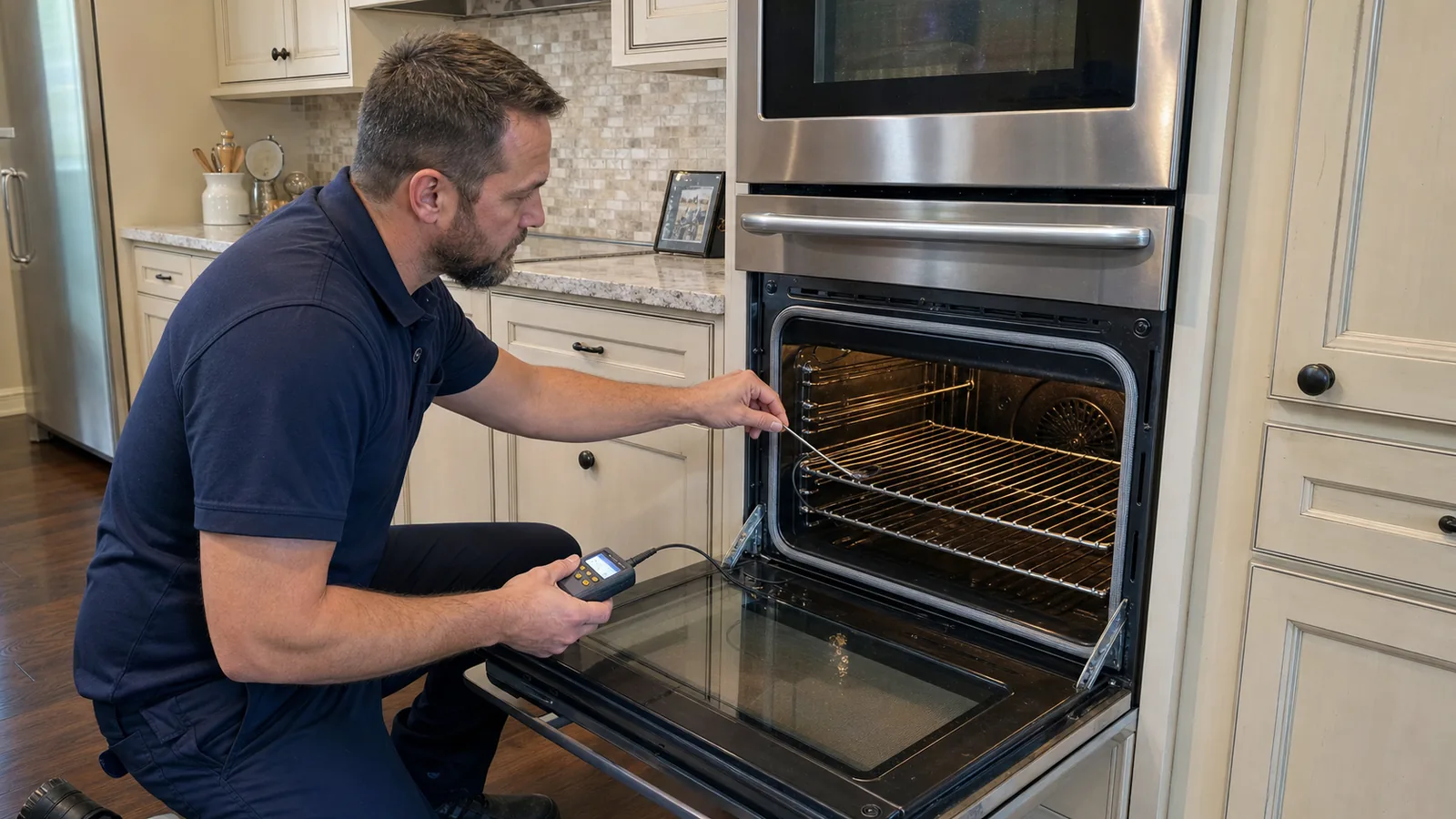
How Do You Document a KitchenAid Oven Temperature Complaint?
Start with repeatable observations: exact oven in a single, double, or combination appliance; mode; setpoint; preheat indication; rack position; thermometer or probe placement; readings across more than one heating cycle; door openings; fan behavior; code; and recent power or cabinet work.
- Keep the sensing device away from direct contact with a rack, pan, wall, door, or heating element unless its instructions specify otherwise.
- Record time and temperature instead of writing only “runs hot” or “does not heat.”
- Separate a slow preheat complaint from low baking temperature, overshoot, uneven results, a dead element, or an intermittent shutdown.
- For a double or combination unit, test and identify each affected cavity separately.
- Stop for smoke, arcing, severe overheating, a damaged door, shattered glass, repeated breaker trips, or gas odor.
These observations guide on-site testing; they do not remotely prove a sensor, element, igniter, fan, relay, control, wiring, power, gas, airflow, or installation failure.
Before changing calibration
Find the exact model’s use-and-care guide. Some models provide owner calibration instructions, but adjustment should follow that document and a credible temperature pattern, not one early reading.
Before running self-clean
Do not use self-clean as a diagnostic step. If the appliance already has a temperature, door, control, wiring, smoke, or overheating concern, record the condition and stop rather than adding a high-heat cycle.
What to send with the service request
Full labelAffected cavityModeSetpointTimed readingsRack positionCode photoWide cabinet view
A short timeline is more useful than naming a suspected part.
Record the behavior before choosing a part
What Common KitchenAid Appliance Symptoms Can Mean
Each card identifies evidence that separates diagnostic paths. A symptom or error code can involve the appliance, installation, utilities, airflow, water, drain, ducting, controls, or more than one condition, so these are starting points rather than remote diagnoses.
Oven Temperature Drifts
Record the affected cavity, mode, setpoint, preheat indication, rack and thermometer position, temperature pattern over more than one cycle, door opening, fan, code, and power history.
Dishwasher Leaves Water
Note the exact cycle stage, standing-water depth, pump sound, filter through normal access, sink/disposal changes, drain route, first leak location, code, and final result.
Refrigerator Is Warm
Record actual temperatures, affected zone, food-safety action, frost or moisture, fans, compressor sound, door and panel alignment, gasket, ice/water, display, and ventilation.
Ice Maker Stops or Leaks
Separate no ice, slow ice, malformed ice, no fill, overflow, drain water, bin or door contact, and display behavior. Note supply, filter, temperature, sound, and first water location.
Cooktop Zone Will Not Respond
Identify gas, radiant, or induction; affected burner or zone; cookware context; ignition or element response; control or lock state; code; breaker or gas history; and any spill or recent work.
Microwave Runs but Does Not Heat
Record built-in, over-the-range, drawer, or combination configuration plus time, power setting, sound, fan, light, turntable, display, door behavior, and code. Never remove the cover.
Vent Fan Is Loud or Weak
Note hood, insert, or downdraft configuration; speed; sound; filter position and condition through owner access; visible airflow; duct or recirculating setup; and changes after cleaning or remodeling.
Code, Noise, Leak, or Reset
Photograph the full code and label. Record cycle or mode, exact stage, temperature, water, heat, airflow, sound, first leak location, power-event history, frequency, and final result.
Exact model first
Where Should You Look for the KitchenAid Rating Plate?
- Dishwasher: left door edge or tub-frame area visible with the door open.
- Refrigerator/freezer: an interior fresh-food or freezer wall, frame, or another product-specific area.
- Range/wall oven: oven, drawer, door, or cavity-frame area visible through normal access.
- Microwave: door, cavity, control-panel, vent, or front-frame area identified by the exact model family.
- Cooktop: the rating plate can be below the appliance and may not be safely owner-accessible.
- Hood/vent: behind a normally removable grease filter or along an inside edge.
- Ice maker/compactor: inside the bin, lid, sliding door, or drawer area.
Photograph the complete label in place. Do not tip, pull, lift, unfasten, disconnect, or reach into unsafe areas solely for identification.
Exact written coverage controls
Could the Appliance Still Have KitchenAid Coverage?
Check the full model and serial, original delivery or purchase date, proof, exact warranty document, household or other use, component-specific terms, prior claims or plans, and current recall or safety notices.
The major-appliance warranty document reviewed for this page contains different terms for listed products and components and directs covered service through authorized KitchenAid providers. Older models, newer documents, specific products, and separate plans can differ.
- Use the official route before independent work when coverage may apply.
- Keep receipts, claim numbers, photos, and written decisions together.
- Confirm whether independent work could affect another claim.
- Do not infer coverage from brand, age estimate, or a search snippet.
KitchenAid or its plan administrator decides coverage. Max cannot approve manufacturer warranty work.
Use diagnosis, condition, access, and total installed cost
Should You Repair or Replace an Older KitchenAid Appliance?
Do not decide from age, appearance, a code, or a single online price alone. Compare the diagnosed fault, exact model, parts support, overall condition, prior history, safe access, cabinet and utility fit, active coverage, household needs, and the full installed replacement project.
Repair can make sense when
- The fault is reasonably isolated and supported by testing.
- Model-correct parts and safe service access are viable.
- The cabinet, liner, tub, cavity, frame, door, wiring, utilities, water, drain, duct, and ventilation are otherwise sound.
- The appliance still fits the opening, panels, household, capacity, fuel, power, and workflow.
- The repair is proportionate to condition, history, remaining value, and installed replacement cost.
Replacement deserves more weight when
- Damage crosses multiple major systems or repeats after prior repairs.
- Corrosion, leakage, unsafe wiring, gas, glass, structure, ducting, or installation creates continuing risk.
- Critical parts are unavailable or access requires disproportionate cabinet work.
- The product no longer fits capacity, accessibility, efficiency, ventilation, or household needs.
- A renovation already requires new panels, trim, floors, counters, utilities, ducts, or openings.
Installed replacement can include delivery, haul-away, floor protection, cabinet or panel changes, trim kit, anti-tip hardware, outlet or hardwiring, gas, water line, drain, ducting, permits, and building access.
Clear intake before parts assumptions
What to Expect From Your KitchenAid Service Request
Useful pre-visit evidence helps match the appointment to the correct product and access needs while preserving safe diagnostic choices.
Step 1
Product and Safety Review
Send the full model/serial plate, product family, symptom evidence, installation, address, and ZIP. Check possible warranty, recall, safety, or official-support routes.
Step 2
Installation-Aware Diagnosis
The technician reviews the exact product, cabinets, panels, utilities, ventilation, reported behavior, and safety, then tests relevant systems where access permits.
Step 3
Findings and Options
You receive the findings and proposed next step before repair proceeds. Parts, labor, access, condition, coverage, and replacement context can be compared.
Step 4
Approved Work and Check
Authorized work is completed when feasible and followed by a relevant functional check. Eligible repair parts installed by Max include a limited 90-day parts warranty; coverage depends on the component and repair.
Local routing with complete-model confirmation
KitchenAid Appliance Repair Across the Tampa Bay Area
Requests are reviewed across Tampa and many nearby Hillsborough, Pinellas, and Pasco County communities. Availability varies by address, route, exact model/configuration, appliance, installation and building access, safety, and parts situation.
All Service AreasTampaClearwaterDunedinSt. Petersburg
Share parking or loading, gate, elevator, stairs, service-hour, floor-protection, authorization, and vendor-document rules plus tight cabinets, custom panels, islands, floors, gas, hardwiring, water, drain, ventilation, and prior damage.
Direct answers for KitchenAid major-appliance owners
KitchenAid Appliance Repair FAQs
Answers about product scope, countertop versus major appliances, built-in access, model and serial labels, oven temperature, dishwasher, refrigeration, error codes, warranty routing, repair versus replacement, scheduling, and independent service.
Which KitchenAid appliances do you repair in Tampa?
We evaluate qualifying KitchenAid major kitchen appliances: built-in and freestanding refrigerators, freezers, dishwashers, gas and electric ranges, wall ovens, cooktops, qualifying built-in and over-the-range microwaves, undercounter refrigeration, beverage and wine centers, ice makers, hoods and vents, warming drawers, and compactors. Service fit depends on the complete model and serial, configuration, cabinet and utility access, condition, symptom, safety, and parts support. KitchenAid’s current U.S. major-appliance navigation is kitchen-focused, so this page does not claim current KitchenAid washer or dryer service.
Do you repair KitchenAid stand mixers and countertop appliances?
This page and Max’s KitchenAid service intake are for qualifying installed major kitchen appliances, not portable countertop products such as stand mixers, blenders, food processors, hand mixers, or toasters. KitchenAid separates major and countertop products in its model-label, manual, support, and warranty systems. If the product sits on a counter and can be carried without disconnecting a household utility or built-in mounting, use KitchenAid’s current countertop-product support route. If you are unsure, send one full product photo and a readable model/serial label before choosing the service path.
Do you repair KitchenAid built-in and panel-ready appliances?
Qualifying built-in, panel-ready, flush, undercounter, column-style, and combination appliances can be reviewed by exact model and installed configuration. Send a wide photo showing cabinet panels, trim, toe kick, floor, neighboring doors and drawers, ventilation openings, utilities, and the path needed to reach or move the appliance. Custom panels and tightly fitted products can change safe access time and the work required before testing. Do not remove a panel, pull a refrigerator, lift a cooktop, disconnect gas or hardwiring, or unfasten a built-in microwave or wall oven just to find the label.
Where is the KitchenAid model and serial number?
KitchenAid’s official locator lists different normal-access areas by product. A dishwasher label is commonly on the left door or tub-frame edge; a refrigerator label is commonly inside a fresh-food compartment wall; a range or wall-oven label may be on a frame or cavity edge visible with the door open; a microwave label may be on the door or front frame; a hood label may sit behind a removable grease filter; and an ice-maker or compactor label may be inside the bin or drawer area. Location varies by model, so photograph the whole label and use the exact manual when normal access does not reveal it.
Why is my KitchenAid wall oven not holding the set temperature?
A temperature complaint needs repeatable evidence before it points to a diagnostic branch. Record which oven in a single, double, or combination unit is affected, cooking mode, setpoint, preheat indication, rack position, observed temperature over more than one cycle, door opening, fan behavior, code, and recent power or cabinet work. A single reading taken too early or beside a wall, rack, pan, or heating element can misrepresent the cavity average. Do not run self-clean, remove panels, adjust calibration, or replace a sensor or control from one reading unless exact-model instructions and testing support that action.
Can you repair a KitchenAid dishwasher that is not draining, washing, or drying?
Qualifying KitchenAid dishwashers can be evaluated for fill, circulation, drain, leak, cleaning, drying, rack, spray, door, noise, control, or code concerns. Record the selected cycle and exact stage, standing-water depth, pump sound, first leak location, water temperature, detergent and rinse-aid use, filter condition through normal owner access, recent disposal or sink work, rack and spray-arm interference, and custom-panel or door alignment. Send the complete tub-frame label plus a wide photo showing the front, toe kick, floor, nearby cabinets, sink base, hoses, and drain connection.
Can you repair a KitchenAid refrigerator that is warm or not making ice?
Qualifying KitchenAid built-in, freestanding, undercounter, beverage, wine, freezer, and ice-maker configurations can be reviewed by exact model. Record actual temperatures, affected compartment, food-safety action, frost and moisture location, fan or compressor sounds, door and gasket contact, custom-panel alignment, ice and water behavior, filter or supply history, display or code, power history, and ventilation clearance. Include the toe kick, top or side ventilation, water line, floor, cabinets, paired columns, and pull-out path. Similar symptoms can involve airflow, defrost, sensing, door, supply, control, installation, or sealed-system branches, so the symptom alone is not a remote parts diagnosis.
What does a KitchenAid error code mean?
A KitchenAid code identifies a condition detected by the appliance; it does not by itself prove that one named part failed. Photograph the complete code and rating plate, then record product type, cycle or cooking mode, exact stage, temperature, water, heat, airflow, fan or pump sound, door or lock state, power-event history, frequency, and final result. Interpret the code only with product literature for the complete model and revision. Do not repeatedly reset a product that has gas odor, arcing, smoke, severe overheating, active leaking, a damaged power connection, or repeated breaker trips.
Should I use KitchenAid warranty service or independent repair?
Check the complete model and serial, delivery or purchase date, receipt, product-specific warranty document, prior claim or extended plan, and any current recall or safety notice before paying for independent service. KitchenAid coverage varies by product, model, component, date, use, proof, and written document. The current major-appliance warranty reviewed for this page directs covered work through authorized KitchenAid service providers and includes product-specific terms, so it should not be reduced to one universal duration. Max Appliance Repair Tampa is independent, cannot approve KitchenAid coverage, and is not the manufacturer warranty route.
Is an older KitchenAid appliance worth repairing?
Age is only one part of the decision. Compare the diagnosed fault, complete model, condition, service history, parts support, safe access, cabinet fit, utilities, ventilation, remaining household value, active coverage, and the total installed cost of a suitable replacement. Repair can make sense when the fault is reasonably isolated, the structure and utilities are sound, and supported parts and access are proportionate. Replacement deserves more weight when damage crosses multiple systems, corrosion or leaks are extensive, safety or access problems are unresolved, critical parts are unavailable, or cabinet and utility changes already make replacement the better whole-project decision.
Is same-day KitchenAid appliance repair available in Tampa?
Same-day appointment options are often available, but they depend on request time, technician route, Tampa-area address, complete model and configuration, appliance and symptom, cabinet and utility access, safety conditions, and parts availability. Call (813) 906-1062 with the full rating-plate photo, symptom evidence, wide installation photo, service address, and ZIP code so the earliest suitable opening can be confirmed. An appointment time is not a promise that every diagnosis or repair can be completed that day, especially when a built-in product needs special access or a model-specific part must be obtained.
Is Max Appliance Repair Tampa authorized by KitchenAid?
No. Max Appliance Repair Tampa is an independent appliance repair company and is not KitchenAid factory service and is not authorized by, affiliated with, or endorsed by KitchenAid or Whirlpool Corporation. KitchenAid names are used only to identify appliances discussed or serviced. For possible manufacturer warranty coverage, a recall or safety notice, a product claim, factory-directed service, or a requirement for an authorized provider, use KitchenAid’s current official support route before arranging independent service.
Sources used for product scope and owner guidance: KitchenAid U.S. built-in appliance categories, model-number locator, product-specific model/serial locations, Owner’s Center, manual finder, warranty explainer, major-appliance limited warranty reviewed, and service and support. Products, terms, contacts, and routes can change; verify the current exact model and document. Symptoms and codes are diagnostic starting points, not remote diagnoses.
Independent service disclosure: Max Appliance Repair Tampa is independent and is not KitchenAid factory service and is not authorized by, affiliated with, or endorsed by KitchenAid or Whirlpool Corporation. Brand names identify appliances discussed or serviced. For warranty, recall, safety notice, product claim, authorized verification, or factory-directed service, use KitchenAid’s current official route.
Brand scope, model/serial, owner-support, and warranty-path information reviewed August 2, 2026. View all appliance brands we repair.
Need Help With a KitchenAid Major Appliance?
Call with the complete model/serial label, exact symptom, installation photos, and Tampa-area ZIP code, or send the information online.