

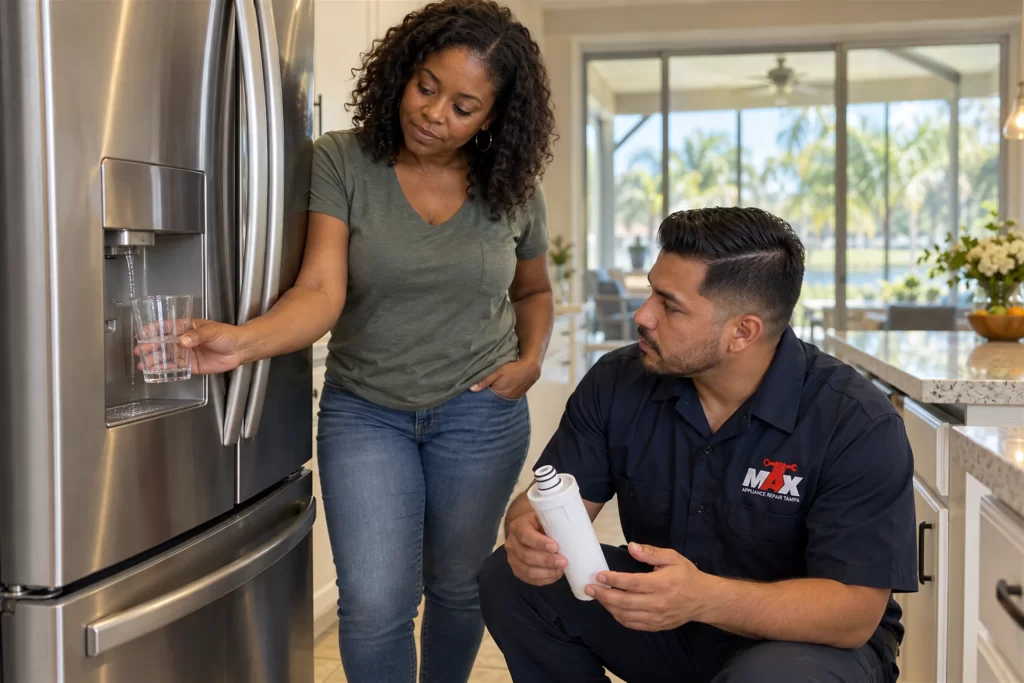
You hold a glass under the lever and wait. What used to fill in a few seconds now takes half a minute, or the water just dribbles out. When a refrigerator water dispenser slow to fill is the only thing wrong, the cause is often simple, and a few checks in the right order can tell you whether it is a ten-minute fix or a service call.
The short version: start with the filter, then the air in the line, then your home’s water pressure. Only after those are ruled out does it make sense to suspect the valve behind the fridge. Match your symptom below and follow the path that fits. If you are in the Tampa Bay area and get stuck, we are a phone call away.
Quick take
A weak stream every day usually points to the filter or the supply. Spitting right after a filter change usually points to trapped air. No water at all, with a fresh filter, is where a technician comes in.
Refrigerator Water Dispenser Slow: Start Here
Before you pick a symptom, answer three quick questions. With a refrigerator water dispenser slow to respond, they narrow things down faster than guessing.
- When did you last change the filter, and did the slow flow start after that?
- Is the ice maker slow or small too, or is it only the water?
- Do other faucets in the house run normally?
The filter, the ice maker and the dispenser all draw from the same supply line. If the ice is also coming out small or sparse, the problem is probably upstream of both. If only the dispenser struggles, look closer at the dispenser’s own path. And if the faucets are weak as well, the fridge may be fine and the supply is the real issue.
One more thing to keep in mind. A dispenser that has slowed gradually over months is a different story from one that dropped off overnight. Gradual slowing fits a filter filling up. A sudden change fits a pinched line, a closed valve or something that just got moved.
Match Your Symptom
Weak Stream All the Time
This is the classic one. The water comes out, it is just thin and slow, and the refrigerator water dispenser slow to fill every glass gets old fast. The most common cause is a filter that has been in place too long and has clogged. A clogged filter cuts the flow to both the dispenser and the ice maker.
Whirlpool’s guidance lists a clogged or overdue filter as one cause and says to replace it about every six months, when the indicator light comes on, or as needed. It adds that heavy use or poor water quality may call for a change sooner.
Pro tip
Write the install date on the new filter with a marker and put a reminder in your phone for six months out. It takes ten seconds and saves you from guessing next time.
Spitting or Dribbling
Sputtering, hollow bursts and a few stray drops after you release the lever all suggest trapped air. It shows up most after a filter change or after the water was shut off for a while.
GE describes dribble as a few drops that miss the glass just after you use the dispenser. Its fix for trapped air is to purge the system by holding the cradle for two to three minutes. Some drops after you pull the glass away are normal, so withdraw the glass slowly and let it catch them.
Slow Only After a Filter Change
If the stream got worse right after you swapped the filter, think installation before you think failure. Whirlpool says an improperly installed filter can reduce or stop the flow, as its page on water dispensing slowly explains. Make sure it is locked in place and sealed.
There is a simple test. Take the filter out of the housing and try the dispenser. If the water runs properly without it, the filter was not seated correctly, so put it back in and lock it. GE offers a similar idea with a bypass plug, described on its slow flow and dribble page: if flow improves with the plug in place of the filter, the filter was the clog.
Then flush. Whirlpool’s steps in its guide to flushing the water system are to hold the lever down for five seconds, release for five, and repeat until the water runs steady, going through at least one to four gallons depending on the filter. Water may spurt while the air clears. Give it 24 hours afterward for the water to chill.

No Water at All
When nothing comes out, run the same filter test first. If the water flows with the filter out and not with it in, you have your answer. If nothing comes out either way, and the filter is fresh and seated, the problem is somewhere between your wall valve and the dispenser.
That stretch includes the shutoff valve, the supply line, the fridge’s own inlet valve and, on some models, the dispenser switch or control. Some of those are visible and some are not, and that is where a technician earns the visit.
Checks You Can Do Safely
A refrigerator water dispenser slow to respond can often be fixed without tools. None of these needs a screwdriver. Work through them in this order and stop as soon as the flow comes back.
- Confirm the filter is locked in and sealed, then try the dispenser with it removed.
- Replace the filter if it has been in longer than the maker suggests.
- Flush the system with short on and off bursts into a sturdy container.
- Run a nearby faucet to see whether the home’s water pressure looks low.
- Check that the shutoff valve to the fridge is fully open.
- Look at the supply line behind the fridge for a kink or a pinch.
On pressure, Whirlpool notes that low water pressure can make water come out more slowly. It also says a reverse osmosis system can lower the pressure further, so if you have one under the sink, the pressure that matters is what reaches the fridge after it.
If you pull the fridge out to look behind it, unplug it first, move it straight and slowly, and keep the line from getting dragged or bent. A line folded behind a fridge that was pushed back too far is one of the more common reasons for a dispenser that went from fine to slow after a cleaning or a move.
Red flag
Water on the floor behind or under the fridge, a wet cabinet nearby or a line that sweats and drips means stop. Close the shutoff valve and call. A small leak in a hidden spot can do real damage over a few days.

What Needs a Technician
Call for service when the refrigerator water dispenser slow flow continues even though the filter is fresh and seated, the system has been flushed and the shutoff valve is open, or when the flow is gone. GE says that if flow stays slow with a new filter or the bypass plug in place, the next step is to schedule service.
At that point the likeliest suspects are the fridge’s inlet valve, a frozen or blocked section of line, or a control that is not telling the valve to open. None of those is something to guess at with a wrench. We send technicians across Tampa, Brandon, Clearwater, Largo and Wesley Chapel, and our team that fixes refrigerators can trace the water path from the valve to the dispenser in one visit.
We diagnose before any repair, and we explain the finding and the estimate before approved work begins. If the fix turns out to be a filter you can swap yourself, we will tell you that too.
This short video walks through a GE refrigerator with slow or no flow from the dispenser, which helps you picture where the water travels.
Good to know
This article is general information, not professional advice. Appliances differ by brand and model, so check your owner’s manual and confirm details with a qualified technician before acting. Max Appliance Repair Tampa is not responsible for decisions made solely on the basis of this article.
Download the free quick guide
A one-page triage list for a slow or stopped water dispenser.
Frequently Asked Questions
How often should the fridge water filter be replaced?
Whirlpool’s guidance is about every six months, when the indicator light comes on, or as needed. Heavy use or poor water quality can mean changing it sooner. Check your own manual, since the interval and the filter model differ by brand.
Do I need to flush the system after changing the filter?
Yes. Whirlpool says to flush the water system as often as you change the filter. Skipping it can leave you with dripping, cloudy water and small or hollow ice cubes. The amount to run through depends on the filter, so read the instructions that came with it.
Why does water spurt or sputter after a filter change?
That is usually air working its way out of the line. Hold the dispenser down in short bursts into a sturdy container until the stream runs steady. If it keeps spitting well after that, the filter may not be seated properly, so take it out and reinstall it.
Is it safe to pull the fridge out and look at the water line?
You can slide it out gently if you unplug it first and your floor is clear, but stay with looking. A kinked or pinched line is easy to spot. Anything that means loosening a fitting or touching the valve is a job for a technician, because a bad connection can leak behind the wall or under the floor without you noticing.
Your Next Steps
- Check the filter’s date and make sure it is locked in and sealed.
- Flush the system in short bursts after any filter change.
- Compare the dispenser with a nearby faucet for pressure.
- Look for a kink in the line and confirm the shutoff valve is open.
- Call us if the flow is still slow or if you see any water where it should not be.
Water still slow?
Call Max Appliance Repair Tampa at (813) 906-1062 or send a request. We schedule seven days a week and explain what we find before any work starts.
